
Orel Zilberman built WriteStack for the kind of creator who's all-in on Substack. Substack handles the writing and publishing beautifully. WriteStack handles the other stuff — scheduling Notes, surfacing analytics, and planning a content pipeline. His vision was a single creator operating system for the platform.
Orel came to the problem with nine years of software development experience, including time at two startups. When he went solo, it took 600 days and more than a dozen failed products before WriteStack started working. It wasn't even the original idea — it started as an AI article outline generator. But after DM'ing early users for feedback, he learned that staying consistent with notes was the real paint point. So he pivoted the whole product around that.
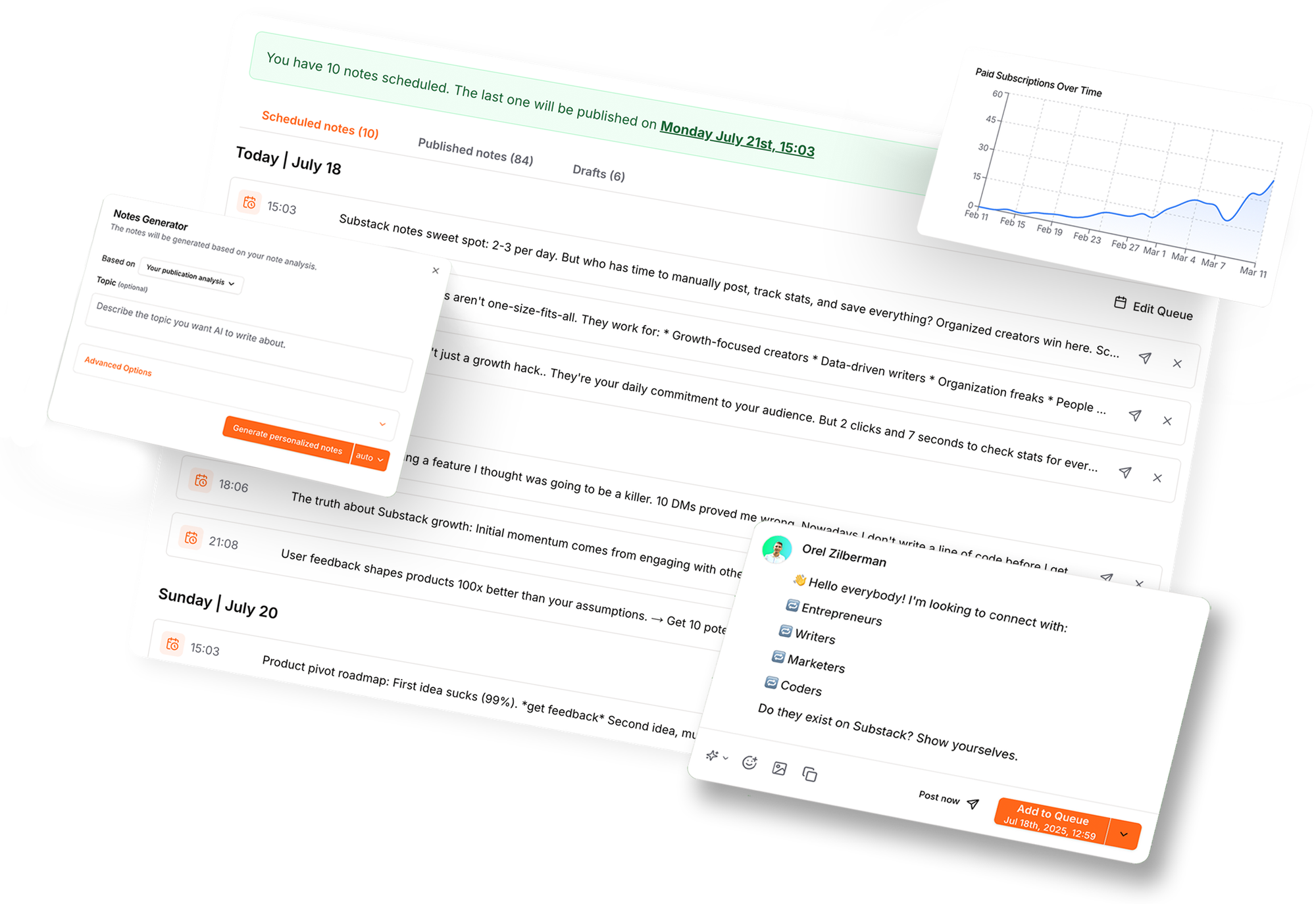
He was clearly onto something. WriteStack has grown to over 360 paying customers and roughly $9,300 in monthly recurring revenue, mostly through organic Substack discovery, Google traffic, and via his own building-in-public content.
But as the product grew, Orel kept hearing the same thing from his users: they were also posting through Buffer, and they wanted WriteStack to meet them there.
How WriteStack and Buffer work together
The initial request was simple enough. Many WriteStack users were already managing their social presence with Buffer, so there was no reason to plug it into another tool. But Orel's reasons for choosing Buffer went beyond convenience.
"When I started getting into Buffer, I fell in love with the experience and the support," he says. "Really, one of a kind."
There was a strategic angle, too. Even if Substack eventually ships its own scheduler, WriteStack still does what Substack won't: get a creator's Notes onto LinkedIn, X, and everywhere else.
The workflow is straightforward from the user's perspective. When you write a Note in WriteStack, you can send it directly to your Substack schedule queue in one click. And with a short setup to connect your Buffer account and choose which platforms you want your content on, every Note you schedule on WriteStack gets automatically scheduled on Buffer as well.
WriteStack handles the Substack side (scheduling, analytics, content management), and Buffer handles distribution to everything else. Creators don't need to copy-paste between tools or maintain separate posting workflows. One action covers both.
What comes next
The Buffer integration is built as an add-on inside WriteStack, designed to slot in without disrupting the core workflow.
WriteStack's users are already asking for more platforms, especially LinkedIn. With Buffer as the distribution layer, Orel doesn't need to build individual integrations for every social network. Buffer handles the where, WriteStack handles the what and when.
For a solo founder managing a growing product, that's a meaningful reduction in complexity. And as the API matures, the integration will only get smoother.
Try it yourself
WriteStack's story is a great example of what the API makes possible: a solo developer, building a product their users love, extending it into cross-platform distribution without rebuilding the wheel. If you're building a tool where your users create content and need it to reach more places, Buffer's API can be that bridge.
Buffer's API is now available. You can start building today.
Try Buffer for free
200,000+ creators, small businesses, and marketers use Buffer to grow their audiences every month.