

As a freelancer, I always wondered, “What would happen if I needed to take an extended medical leave?”
I’m not the kind of person to take a month-long trip, and I’ve never taken more than 7-10 days off at a time (which requires meticulous planning ahead of time!). If I don’t work, my revenue is $0. I run a solo business, so my income is 100% dependent on me. So what would happen if I couldn’t work?
Would my clients understand?
Would my social media engagement take a nosedive?
Would my business crumble?
I found out this year when I was diagnosed with a brain tumor. Not exactly what I was expecting. I needed brain surgery, and recovery was expected to take a minimum of six weeks — possibly longer.
I only had six weeks between my diagnosis and surgery. I’ve always been a Highly Organized Person, so I kicked into gear. Preparing for an extended medical leave — including preparing my social media — was necessary as a solo business owner. It also gave me a sense of control when so many other things felt outside of my control.
Here’s what I did.
The importance of social media for my business
Three years ago, I started my freelance writing business, writing long-form content for B2B SaaS companies, mostly fintech. My social media presence has been crucial for my business. I’m active on LinkedIn, and it’s one of the main ways clients find me.
Almost all of my business is inbound, either through LinkedIn or my website (and I’m pretty sure that website inquiries find me on LinkedIn first). I typically schedule two posts per day, plus spend time engaging with other people.
I also create resources for solopreneurs and share content on other social media platforms (like Threads) — though I’m not depending on them to find clients right now. (Outside of LinkedIn, my social media presence is more geared towards supporting fellow freelancers and solopreneurs.)
I know that might sound like a lot, but I have a really efficient system that helps me do all this. I chatted with Buffer about it a few months back, if you’d like to learn more:
Even with that system in place, going silent on social media for such a long period of time made me nervous. I thought the algorithms would punish me if I “disappeared,” making it harder to ramp up again later.
My plan for this extended time off was to do what I could to keep my social media presence as active as possible. Even if I couldn’t engage with other people, I could pre-schedule content for my profiles.
How I prepared to step away
I figured I would need enough content to cover eight weeks of medical leave. I let a few of my social profiles go silent, but I wanted to keep LinkedIn, Threads, Bluesky, and my LinkedIn Company Page active.
Reduced my posting frequency
I created a Google Sheet to track the number of posts I needed to create for each profile to cover eight weeks. LinkedIn, for example, was twice a day, every day. At 14 posts per week, I needed to write 112 posts… on top of writing regular social media content in the weeks leading up to surgery.
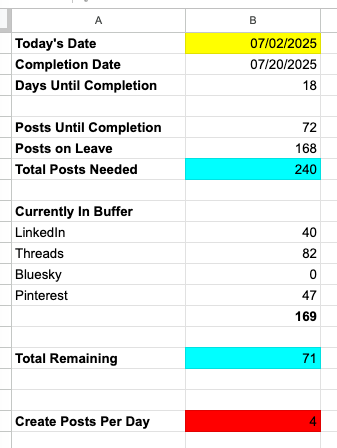
I quickly realized that I could not write enough posts to cover my posting frequency. Social media wasn’t the only thing I needed to worry about. I also have long-form content (like my Substack), along with client work. And aside from my business, I also needed to write notes and instructions for my parents, who would be taking care of my kids while I was in the hospital.
In the end, I changed my Posting Schedule in Buffer to reduce the Posting Times for each channel. I post a lot, but asked myself, “What’s a reasonable amount to keep my profile active?” I reduced the number of posts to less than half of my normal volume. Instead of posting twice a day on LinkedIn, I decided to post once per day and skip weekends.
Relied on my backlog of potential posts
Another step in my preparation was going through my backlog of content ideas. I have a very large repository of ideas for social media posts. Hundreds. I had no shortage of ideas… just not enough time to do the actual writing.
I accumulate post ideas from automations I have set up. Zapier creates draft social posts based on my long-form content and podcast transcripts. I use a combination of Zapier and ChatGPT to rewrite posts from one platform (LinkedIn) so that they fit the vibe of another platform (Threads). I also re-share links to blog posts I’ve written in the past.
Once I’d reduced my Posting Schedule in Buffer, I started working through my queue of ideas. Some had drafts that only needed a small amount of editing. Others were nothing more than a passing thought.
I try to share a variety — text-based posts, images, and links — so I worked through my backlog until I’d created enough posts for eight weeks of content.
Asked friends to help
I was worried about “posting and ghosting.” The rumor on many social platforms is that if you post and don’t engage, you’ll diminish your reach.
Even though I’ve always pre-scheduled my content, I’m always on the social platforms to engage with people throughout the day.
A few friends asked how they could help. I asked them to engage with my posts by either reacting or commenting. I hoped the algorithms wouldn’t punish me too badly if there was some engagement on my posts. It was a way they could help that didn’t require too much effort.
For the first few weeks after my surgery, I wasn’t able to log into my social platforms at all. I had some vision issues and couldn’t handle the glare from screens. During that time, my friends came through for me. Some even re-shared my content to their own networks.
Why I paused my Buffer queue
I managed to hit my goal. By the time my surgery date arrived, my Buffer queues were full and ready. Eight weeks of content, carefully planned and pre-scheduled.
However, I eventually paused my Threads queue in Buffer while I was recovering. At the time, I still had more than 90 posts in the queue.
As soon as I was able to type, I started sharing real-time updates on Threads. Whenever I shared updates, I got a lot of support and encouragement — from complete strangers. Lots of people replied, “You’ve got this!” or “I had brain surgery also, I know what you’re going through.”
Because of this, it felt weird to intermix posts like “I had a follow-up appointment with my neurosurgery team today” and pre-scheduled content like “Here are tools you can use to organize your freelance business!”
Once I was back to work, I unpaused my queue and re-shuffled my posts into new Posting Times.
Returning to my social media routine
Six weeks after my brain surgery, I started working again at a very low level. I knew I had a few weeks of pre-scheduled content left, and then I’d need to start writing posts again.
It has been harder than I thought. At first, I was fighting fatigue and needed to put my energy into my client work. A few more weeks passed, and I still struggled to get back to my normal routine with social media posts.
Perhaps I should have planned for a longer leave and pre-written 10 weeks of content instead of eight. That way, I would have had more of a buffer (pun intended?) as I ramped back up. But I’m not sure that would have been realistic, given my time constraints.
However, the experiment with fewer posts was a good one. I don’t feel like my business fell apart. I’m glad I pre-scheduled content to keep my profiles active, but I’m also glad that I gave myself some grace to write less.
During my leave, my inbound leads slowed substantially. I had fully prepped my virtual assistant to respond to leads when I couldn’t, but she barely had to do anything. I don’t know this for sure, but my gut says that people saw on my LinkedIn profile that I was recovering from surgery — even though I only posted occasional updates. Once I was back to working (and made an announcement to that effect), the inbound leads resumed.
Do what works for you
I would never tell someone that they need to do as much prep work as I did. I was lucky that I had several weeks to prepare, but it might have been a very different situation if I’d needed more immediate medical attention.
I also found the prep work to be a good distraction. However, that’s my personality. I could have instead taken the time to focus on other things.
You matter most in your business. If writing social media posts in advance of a medical leave stresses you out, don’t do it. Step away, and your social media accounts will be waiting for you when you’re ready.
Try Buffer for free
190,000+ creators, small businesses, and marketers use Buffer to grow their audiences every month.


