
They say comparison is the thief of joy, but I’d argue that comparison (when done right) can be one of the core ingredients of social media success. It can help you understand what keeps your social media audience coming back.
Here’s a list of the 11 best competitor analysis tools to help you get detailed data on your competitors, analyze trends they use, and get a clearer picture of competitor performance benchmarked against yours. These picks span social media monitoring, SEO analysis, audience research, and brand tracking, so there’s something here no matter where you focus your efforts.
Key takeaways
- Best for YouTube channels: vidIQ — free plan covers 150 AI Credits every month, paid from $19/month with 2,000 AI Credits
- Best on a tight budget: Social Status — competitor analytics from $9/month
- Best for SEO gaps: Ahrefs — free tier available, paid from $29/month
- Best for tracking every channel at once: Competitors App — from $29.90 per competitor per month
- Best for audience research: SparkToro — 3 free reports a month, paid from $50/month
- Best for cross-network social benchmarking: Socialinsider — from $99/month
- Best for website traffic and market share: Similarweb — from $125/month
- Best for search and AI visibility: Semrush — free plan available, paid from $139/month
- Best for trending content: BuzzSumo — from $199/month
- Best for agency reporting: Rival IQ — from $239/month
- Best for brand mentions: Brand24 — from $249/month
- Cheapest way to start: vidIQ, SparkToro, Ahrefs, Semrush, and Social Status all offer free accounts, although competitor-analysis features vary by plan.
Jump to a section:
- The 11 best competitor analysis tools compared
- What is a competitor analysis tool?
- Do you need a competitor analysis tool?
- How to choose the right competitor analysis software
- 1. vidIQ: best competitor analysis tool for YouTube
- 2. Social Status: best cheap competitor analysis tool for solo creators
- 3. Ahrefs: best SEO competitor analysis tool for backlink and keyword gaps
- 4. Competitors App: best competitor monitoring tool for every marketing channel at once
- 5. SparkToro: best competitor research tool for audience insights
- 6. Socialinsider: best social media competitor analysis tool for cross-network benchmarking
- 7. Similarweb: best competitor website analysis tool for traffic and market share
- 8. Semrush: best competitor analysis tool for SEO competitive analysis
- 9. BuzzSumo: best competitor content analysis tool for trending posts and shares
- 10. Rival IQ: best social media competitor analysis tool for agency reporting
- 11. Brand24: best competitor monitoring software for brand mentions
- Know when to close the tab
- FAQ about competitor analysis tools
- More social media marketing resources
The 11 best competitor analysis tools compared
Here's how the 11 tools compare in terms of coverage, free access, and entry price. Rows are ordered from cheapest to most expensive.
| Tool | Best for | Channels covered | Free option | Starting price |
|---|---|---|---|---|
| vidIQ | YouTube competitor tracking | YouTube | Free plan (3 competitors) | $19/mo |
| Social Status | Competitor analytics on a budget | All major social networks | Free plan (excludes competitor analytics) | $9/mo |
| Ahrefs | Backlink and keyword gaps | SEO, PPC, AI search | Ahrefs Free | $29/mo |
| Competitors App | Tracking every marketing channel | Social, email, PPC, SEO | 15-day trial | $29.90/competitor/mo |
| SparkToro | Competitor audience research | Audience, search, podcasts, newsletters | Free plan (3 reports/mo) | $50/mo |
| Socialinsider | Cross-network social benchmarking | All major social networks | 14-day trial | $99/mo |
| Similarweb | Website traffic and market share | Web, referral, search, apps | Free trial | $125/mo |
| Semrush | Search and AI visibility | SEO, PPC, social, AI search | Free plan | $139/mo |
| BuzzSumo | Trending content and shares | Blogs, content, Facebook Pages | 50-search trial | $199/mo |
| Rival IQ | Agency benchmarking reports | All major social networks | 14-day trial | $239/mo |
| Brand24 | Competitors' brand mentions | Social, web, news, AI search | 14-day trial | $249/mo |
Pricing verified August 2026. Annual billing, taxes, promotional discounts, add-ons, seats, and usage-based charges may change the final cost.
What is a competitor analysis tool?
A competitor analysis tool is software that collects and reports public data about your competitors (their social posts and engagement, search rankings, ads, email campaigns, brand mentions, and audience), so you can benchmark your own performance against theirs.
Most fall into one of four categories:
- Social media monitoring: engagement, follower growth, mentions, and post performance
- SEO analysis: organic keywords, backlinks, estimated traffic, and content gaps
- Direct marketing tracking: email campaigns, SMS, and paid ads
- Competitive intelligence: market positioning, funding, headcount, and historical performance
Knowing which category you need is the fastest way to avoid paying for features you'll never use.
Do you need a competitor analysis tool?
You don't always need a tool for competitor analysis. If you're in the early stages of forming your social media marketing strategy, I'd argue you don't need to focus on what your competitors are doing at all. Focus on refining your systems, creating a solid content calendar, and building a community. Watching what the competition is doing comes later, if it comes at all.
Manual competitor analysis
If you're on a tight budget, you can skip the software entirely:
- Identify your top three direct competitors.
- Find gaps in their strategy or product offerings.
- Meet your audience's needs better, based on those gaps.
It's also worth learning to audit your own accounts first. Most of what a competitor tool tells you only makes sense once you know your own numbers.
How to choose the right competitor analysis software
Look for a tool that shows you more than your direct rivals. You'll need the big picture too. Think broader trends, even outside your industry) and the ability to surface patterns across more than one of your channels.
The weird thing about social media is that, in a way, everyone is your competition. Not just the top ten industry leaders. Every creator and small business wants a slice of their audience's limited attention.
Go deep on your direct competitors by all means, but the more interesting ideas usually come from outside your niche. If every skincare brand is running the same three formats, the one worth copying is probably running in food, or fitness, or somewhere you're not looking.
Here's what I looked at when I put this list together:
- Does it show you broader trends, or only the competitors you name? A tool that reports on five companies you already watch will keep you making the same content they do.
- How many marketing channels does it cover? Most of these tools are on the expensive side. I've included cheaper single-channel options where they're worth it, but the picks near the top cover more than one thing: organic traffic, paid campaigns, and social engagement in the same dashboard.
- Can you get something useful out of it the same afternoon? Nobody wants to sit through another onboarding call because the software is too complicated to work out alone. I've favored tools you can sign up for and get a first report from without a demo.
- Does it cover the type of analysis you actually need? See the four categories above. Paying for competitive intelligence when what you wanted was engagement benchmarking is the most common way to waste money here.
- Does it track AI search visibility? AI search visibility is becoming a super helpful part of competitor research. Availability and depth vary by tool and plan, so check the current feature set before choosing one.
👀 Before you look at that pricing column and panic: four of these start at $139 a month or more, and they're priced for teams with a reporting line to answer to. If you're a solo creator or running social for a small business, vidIQ's free tier and SparkToro's three monthly reports will cover most of what you need, and our free competitor analysis guide covers the rest with a spreadsheet.
Right, onto the tools.
1. vidIQ: best competitor analysis tool for YouTube
Best for: YouTube competitor tracking
Channels covered: YouTube
Free option: Free plan with 150 AI Credits every month
Pricing: From $19/month (Boost)
Alternatives: TubeBuddy, Tubular
Top features:
- Track a competitor's subscriber growth, best-performing videos, and views per hour
- Has a Chrome extension for easy and convenient competitor analysis
- Export competitors’ keywords in a few clicks
vidIQ is a YouTube tool through and through. It can help you find keyword ideas, create video thumbnails, and audit your competitors’ channels against yours.
For a competitor analysis, all you have to do is enter your competitors’ channel(s), and vidIQ will analyze and compare your YouTube channel’s performance with theirs. You'll get a list of their best-performing videos, and from there you can sort by views per hour (VPH), publish date, total views, and engagement.
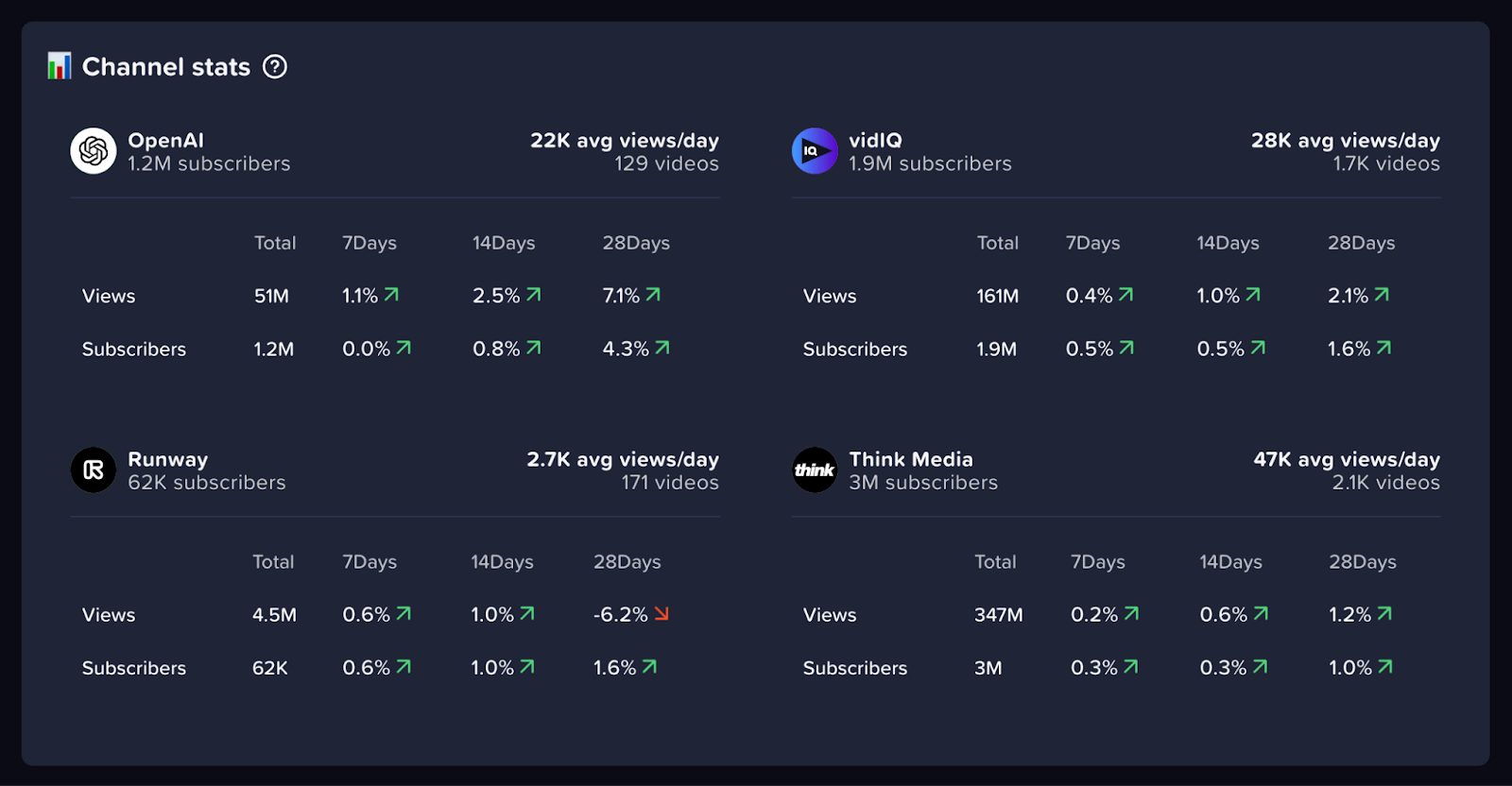
What I love about vidIQ is that you can find evergreen topics for your YouTube videos by spotting patterns in your competitors’ VPH metrics. If you're a productivity creator and every competitor's "time management" video is still climbing three years on, that's a topic that will always be relevant for your audience.
vidIQ is the right pick if YouTube is your main channel and you want competitor data without paying for a platform that also covers five networks you don't use.
2. Social Status: best cheap competitor analysis tool for solo creators
Best for: Competitor analytics on the smallest budget that still works
Channels covered: All major social networks
Free option: Free plan, but it excludes competitor analytics
Pricing: Competitor analytics starts on Micro at $9/month
Alternatives: Socialinsider, Rival IQ
Top features:
- Benchmark your likes, comments, and shares against named competitors
- Cross-network reporting without an agency price tag
- Exportable reports on the lower tiers, not just enterprise
Social Status is the cheapest entry point in this list, and it's the one I'd point a solo creator at first. It benchmarks your performance against competitors on the basic metrics (likes, comments, shares, follower growth) across the major networks.
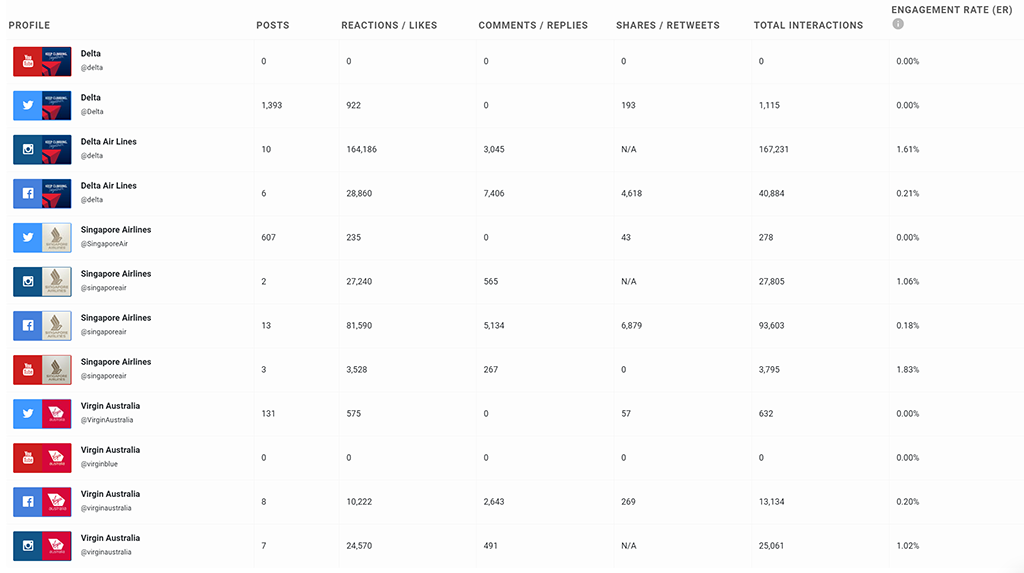
The free plan does not include competitor analytics, so the real starting price is $9. And the interface is noticeably plainer than Rival IQ's, which matters if you're putting screenshots in front of a client.
Social Status suits creators and small businesses who want competitor numbers in a spreadsheet-style tool and don't need the reporting polish they'd pay four times as much for elsewhere.
3. Ahrefs: best SEO competitor analysis tool for backlink and keyword gaps
Best for: Finding the keywords and backlinks your competitors have, and you don't
Channels covered: SEO, PPC, AI search
Free option: Ahrefs Free, limited Site Explorer and Site Audit
Pricing: From $29/month (Starter)
Alternatives: Semrush, Moz
Top features:
- Content Gap shows the terms competitors rank for, and you don't
- Backlink profiles for any domain, including who links to your rivals and not you
- Brand Radar tracks how often you and your competitors appear in AI answers
Ahrefs earns its place for anyone whose competitors are winning on search and who wants to know exactly which pages and links are doing it. You can monitor a competitor's organic traffic, pinpoint content gaps, and take some of that search traffic for yourself.
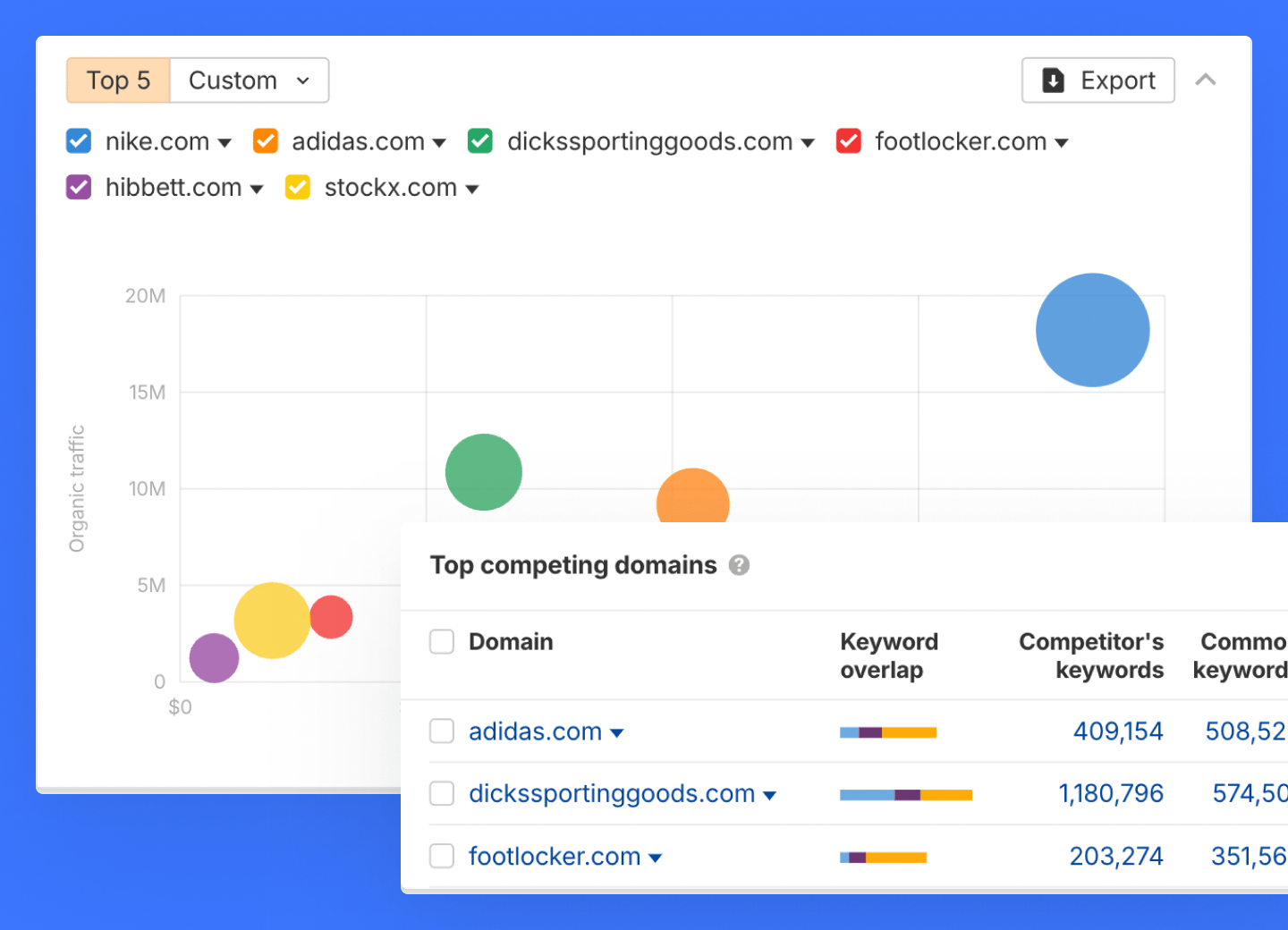
There's a free tier, and the paid entry point is $29/month with the Starter plan, which puts serious SEO competitor data within reach of a solo marketer for the first time. Ahrefs also offers Brand Radar AI as a separate add-on, starting at $199/month for a single AI platform.
4. Competitors App: best competitor monitoring tool for every marketing channel at once
Best for: Watching social, email, ads, and SEO for the same competitor in one place
Channels covered: Social, email, PPC, SEO
Free option: No free plan; 15-day trial
Pricing: From $29.90 per competitor per month (currently discounted to $14.95)
Alternatives: Similarweb, Mention
Top features:
- Track your competitors’ social media, email marketing, paid traffic, PPC research, and keyword tracking
- Monitor competitors’ reviews to adjust your brand positioning
- Get all the competitor research delivered to your inbox
Competitors App covers a lot of ground. You can get a detailed view into every single one of your competitors, including their website changes, PPC campaigns for Google Ads, competitor email campaigns, and keyword rankings. It's added AI summaries and sales battle cards since I last looked, though it has no AI-search visibility tracking.
Competitors App is a great fit if you’re managing multiple marketing channels (think social media, email, and SEO) and want all your competitor data in one place. Enter your competitor websites, and the software will do real-time monitoring for you.
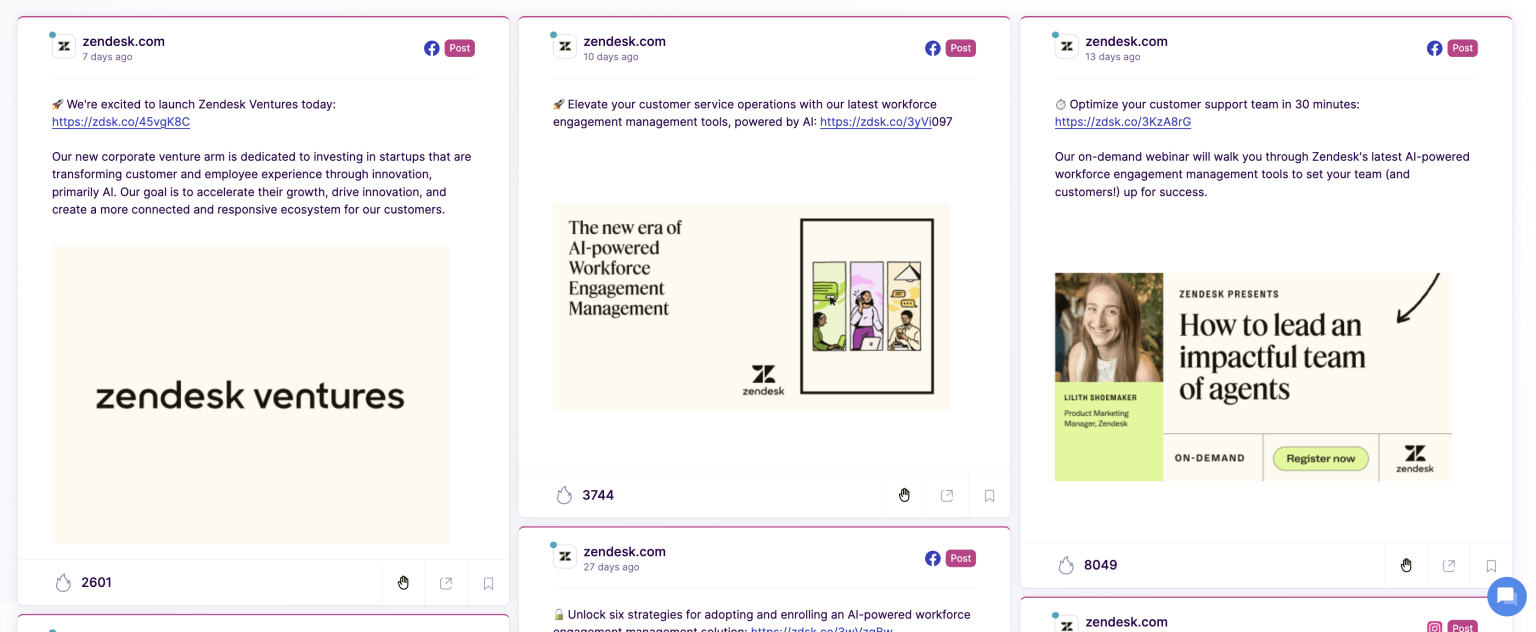
The pricing model is the catch: $29.90 is per competitor per month, so tracking five rivals is $149.50 before you've added a second seat. Worth doing the arithmetic before the trial ends.
5. SparkToro: best competitor research tool for audience insights
Best for: Working out where your competitors' audience already spends time
Channels covered: Audience, search, podcasts, newsletters, social
Free option: Free plan, 3 reports a month (preview data only)
Pricing: From $50/month (Personal)
Alternatives: Audiense, YouScan
Top features:
- Shows the podcasts, newsletters, and accounts a competitor's audience follows
- Finds advertising opportunities by mapping where that audience actually is
- Surfaces the search keywords your audience uses
SparkToro is technically an audience research tool, but it doubles as a seriously useful competitive intelligence platform, especially for small and medium businesses.
Comprehensive data about your audience is one of the most crucial parts of a cohesive social media strategy. The problem? You don't have an audience when you're starting out. You're at zero followers. How do you understand your audience then? You borrow someone else's. Your competitors' audience is, more or less, your audience; they just found them first.
Enter a competitor's website and SparkToro tells you which podcasts their audience listens to, which newsletters they subscribe to, and which accounts they already follow. That last one is the useful bit — it's a ready-made list of people to study, or to pitch.
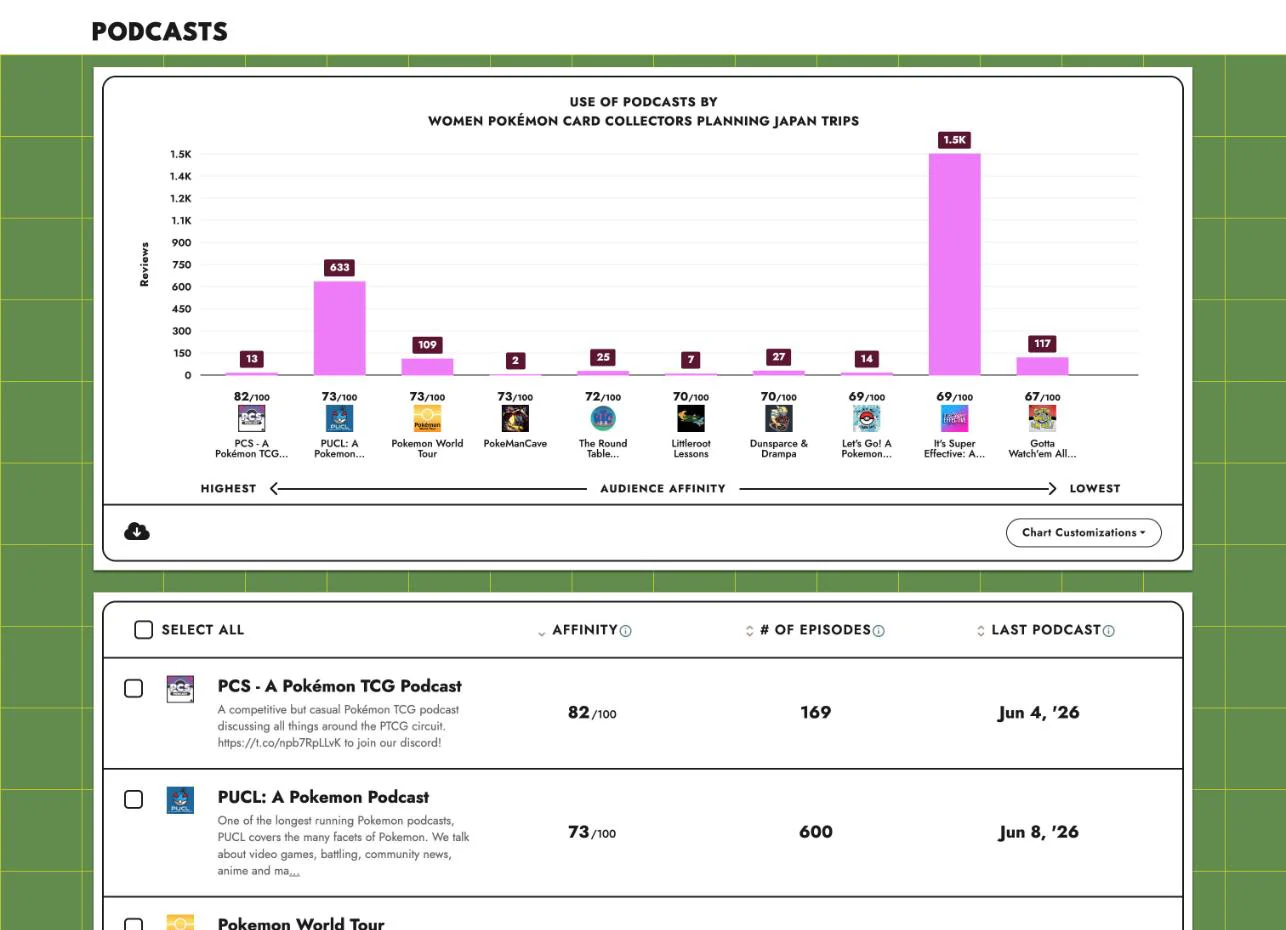
That's pretty helpful for social listening when you're still building a community, though if listening is the main job you want, dedicated social listening tools will go deeper.
One caveat worth knowing: the free tier is narrower than it used to be, with three reports a month, preview data only. And the data thins out fast for niches with small online audiences.
6. Socialinsider: best social media competitor analysis tool for cross-network benchmarking
Best for: Comparing your social performance with named competitors and industry averages
Channels covered: All major social networks
Free option: No free plan; 14-day trial, no card
Pricing: From $99/month (Adapt)
Alternatives: Rival IQ, Social Status
Top features:
- Competitor benchmarking included on every plan, not just the top tier
- Cross-network comparison in a single report
- Industry averages to check whether a bad month is you or the platform
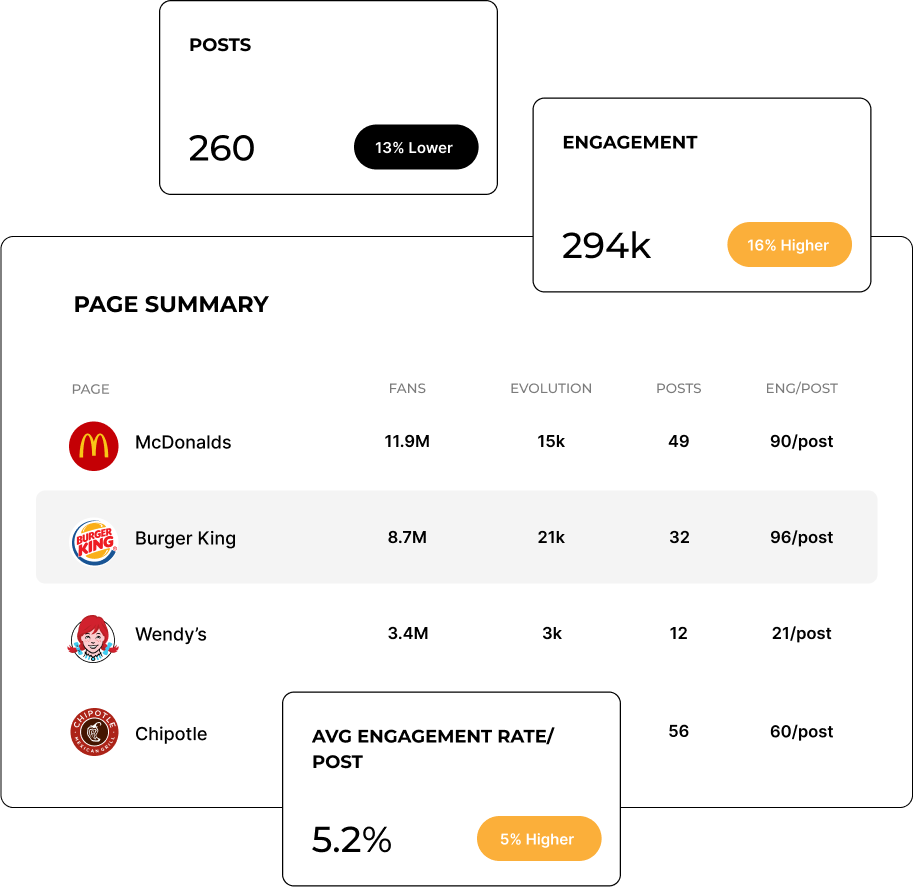
Socialinsider is the sensible middle option for in-house social teams who need real benchmarking without an agency budget. It sits in the gap between Social Status and Rival IQ — more depth than the budget option, roughly a third of the price of the agency one. Competitor benchmarking is on every plan, which is not true of most tools here.
7. Similarweb: best competitor website analysis tool for traffic and market share
Best for: Estimating how much traffic a competitor's website gets and where it comes from
Channels covered: Web, referral, search, apps
Free option: Free trial (length not published)
Pricing: From $125/month
Alternatives: SpyFu, Semrush
Top features:
- Traffic estimates and traffic sources for any domain
- Market share and audience overlap against a set of competitors
- Referral and channel breakdown, including which partners send them visitors
Similarweb answers a different question from everything else here: not "what are they posting" but "is it working". It estimates a competitor's website traffic, where that traffic comes from, and how much of the category they hold.
For a social-first reader, the most useful view is the referral breakdown. It shows you which social networks are actually sending a competitor visitors, rather than which ones they post on most. Those are often not the same network, and it's a cheap way to find out you've been investing in the wrong channel.
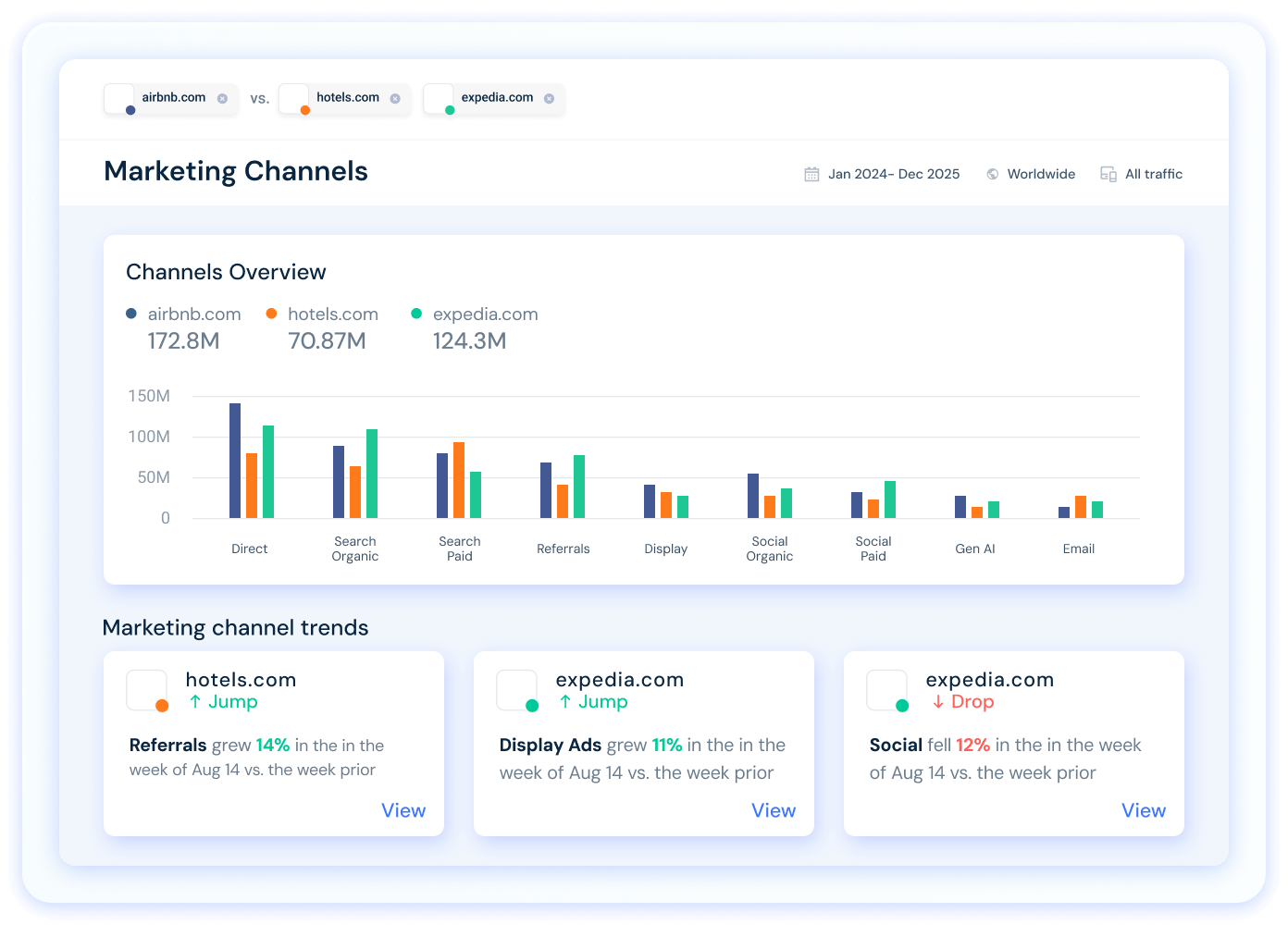
For what it's worth: The estimates are estimates, and they're least reliable for small sites, so treat the numbers as directional at best.
Similarweb is worth it if you're benchmarking a business against named competitors and need traffic and market-share figures rather than engagement metrics.
8. Semrush: best competitor analysis tool for SEO competitive analysis
Best for: Seeing a competitor's whole search presence, including AI search
Channels covered: SEO, PPC, social, AI search
Free option: Free plan (1 project, no card); 7-day trial on paid plans
Pricing: From $139/mo (SEO plan); $117.33/mo billed annually. Starter $199, Pro+ $299
Alternatives: Ahrefs, Phlanx
Top features:
- Benchmark your website traffic against competing domains and find keyword gaps
- Social media tracker for competitor content and audience growth
- AI visibility tracking across Google AI, ChatGPT, Perplexity and Gemini, built into paid plans
Semrush is one of the top SEO competitor analysis tools. Although it also has a social media tracker to keep tabs on your competitors' social media activity, it’s best suited for businesses with a search engine optimization strategy.
You can benchmark your website traffic against competing websites, find keyword gaps, and get an in-depth analysis of your competitors’ ads. Semrush has also expanded into market analysis and AI brand sentiment tracking, so you can get a broader view of how competitors are positioned — not just in search, but across their entire digital presence.
In social media, you can track your competitors’ content and audience growth. Semrush also provides valuable insights about the most successful hashtags, posts, and accounts in your niche.
All you have to do is add your and your competitors’ social media profiles. Even if you enter just their domain name, Semrush will try to find their profiles across social networks. You can view their top posts, most popular hashtags, and dive deep into multiple social networks.
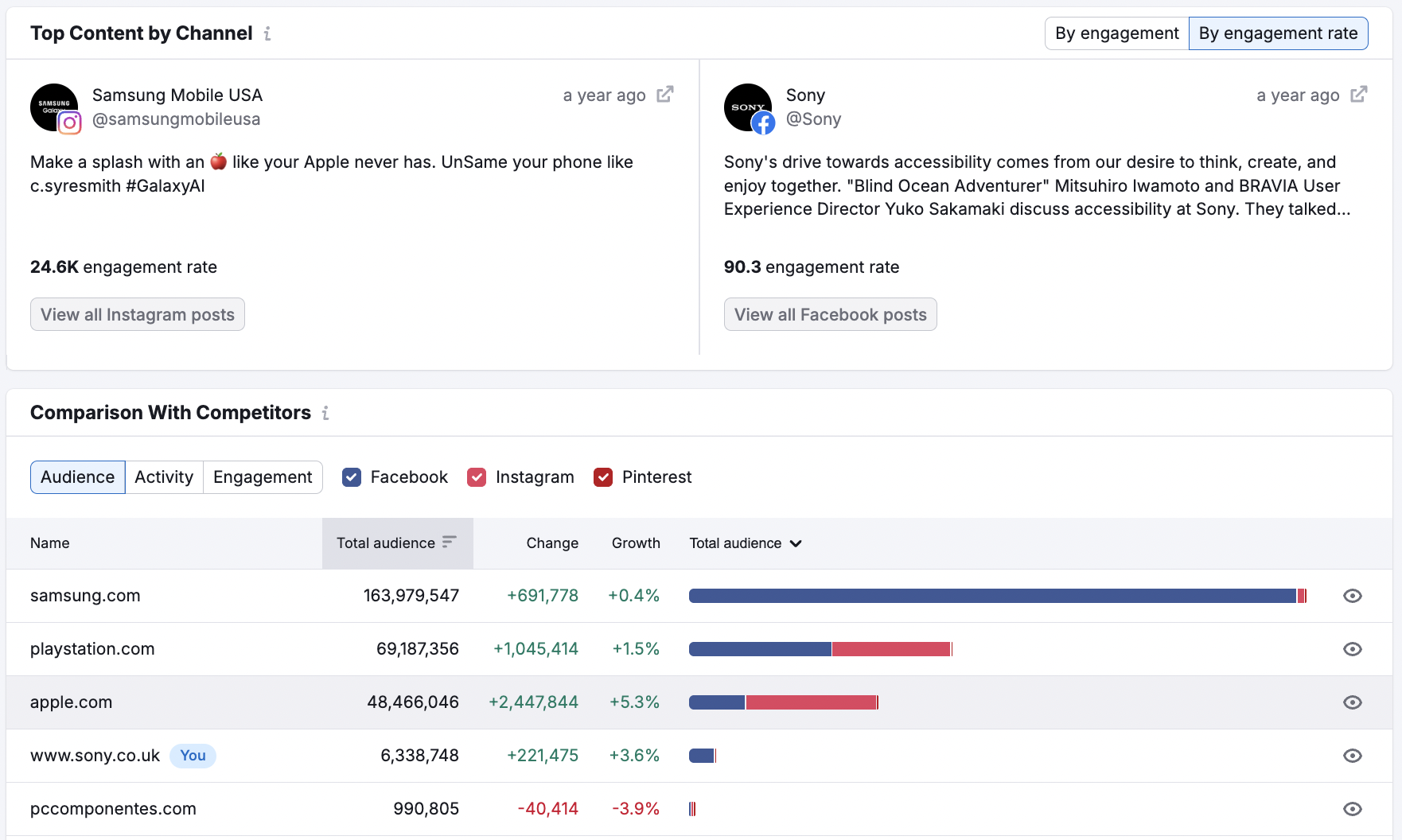
Semrush is perfect for any creator or business with a strong SEO content strategy. Its SEO competitor research features are powerful, but it doesn’t go that deep into social media competitor strategies. You can work both in tandem and do a combined competitor analysis.
9. BuzzSumo: best competitor content analysis tool for trending posts and shares
Best for: Finding which of a competitor's content actually travels
Channels covered: Blogs, content, Facebook Pages
Free option: No free plan
Pricing: From $199/month (Content Creation)
Alternatives: Brandwatch, Meltwater
Top features:
- See which of a competitor's posts and articles earned the most shares
- Spot content trends and engagement patterns over time
- Compare up to 10 competitor Facebook Pages (on the PR & Comms plan)
BuzzSumo is a content marketing tool at its core, but its features lend themselves well to competitor analysis, too. You can quickly analyze your competitors’ content and check out what’s working well for them: Which blogs are getting the most social media shares? Which social channel is working the best?
It also compares Facebook Pages, but the comparison is capped at 10 pages and sits on the $299/month PR & Comms plan, not the $199 entry tier. And Meta deprecated deep post-level Facebook analysis back in 2020, so what you get now is page-level aggregate trends rather than a breakdown of individual competitor posts. If Facebook Pages are your main channel, know what you're buying before you upgrade.
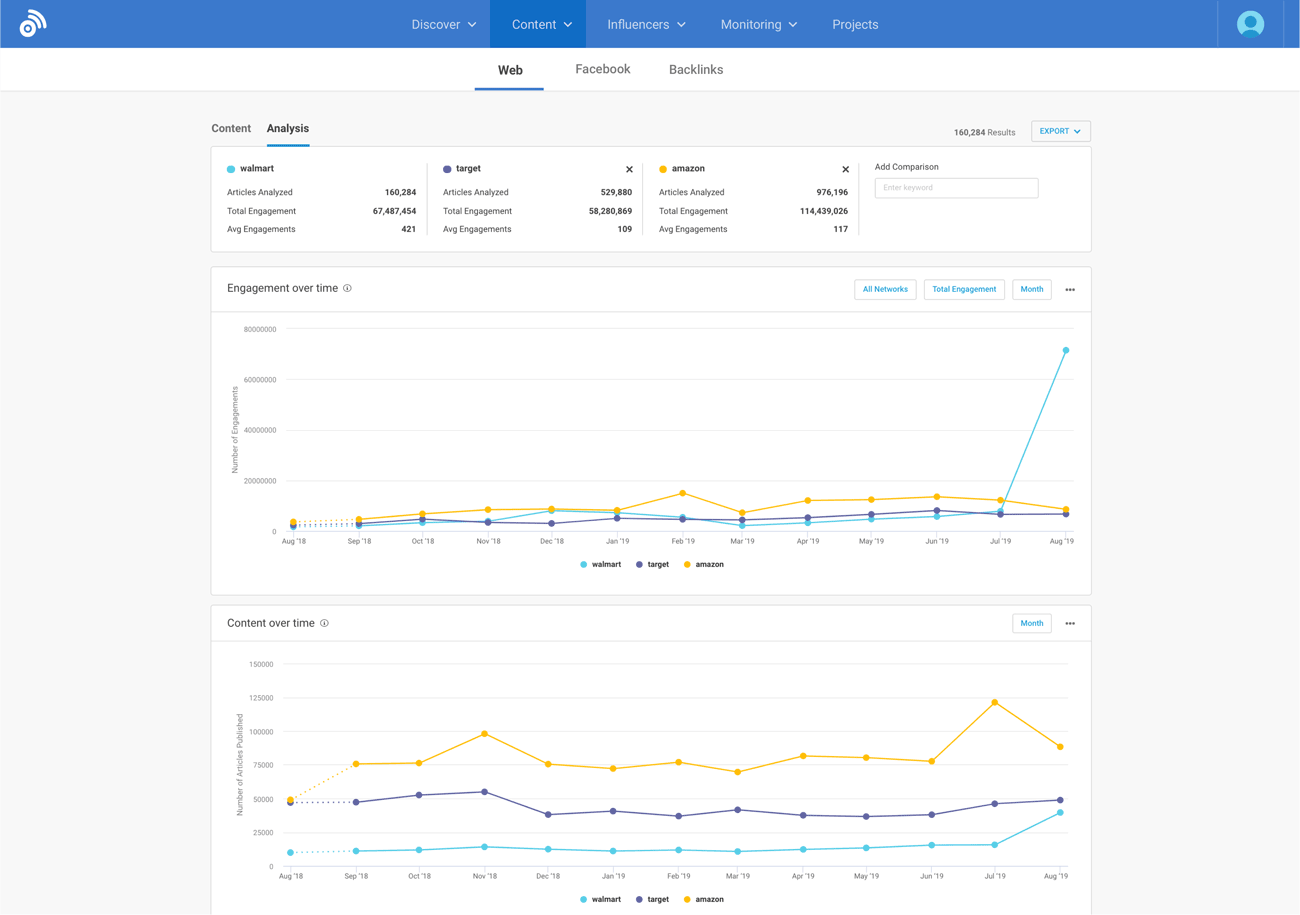
BuzzSumo suits content teams who need to know which topics travel in their category, not just how a rival's social accounts are performing. At $199/month, this is hard to justify for competitor content research alone. It earns its keep if you're also using it for your own content planning and keyword research from the same subscription.
10. Rival IQ: best social media competitor analysis tool for agency reporting
Best for: Benchmarking reports you're going to put in front of a client
Channels covered: All major social networks
Free option: No free plan; 14-day trial, no card. Free head-to-head reports available without a subscription
Pricing: From $239/month (Drive)
Alternatives: Socialinsider, Social Status
Top features:
- Get notified every time a competitor posts on social media
- Compare your social media performance with industry averages
- Receive raw data on market position, too
Rival IQ is a bit like a social media management tool that doubles as the most thorough competitor analysis tool in this list. It tracks competitors' social media bios, organic posts, boosted posts, hashtags, and follower growth, and flags when any of them change.

You can set up alerts to get notified every time a competitor posts on their social media channels. Even more usefully, you can compare your own performance against industry benchmarks alongside specific competitors. (Industry-average benchmarking is the feature agencies actually pay for here — it's what turns a screenshot into a client report.)
At $239 per month, Rival IQ is especially well-suited for social media managers and agencies that need to deliver benchmarking reports, whether for a single brand or multiple clients. You get a comprehensive dashboard full of focus companies (your direct competitors) and industry averages.
11. Brand24: best competitor monitoring software for brand mentions
Best for: Knowing what people say about your competitors, and where
Channels covered: Social, web, news, AI search
Free option: No free plan; 14-day trial, no card
Pricing: From $249/month (Individual)
Alternatives: Meltwater, Mentionlytics
Top features:
- Track mentions and reach for any competitor keyword
- See which of their content and topics earns the most conversation
- Sentiment analysis on how people talk about them
Brand24 is an AI-powered monitoring tool for keeping tabs on competitor activity like mentions, reach, and best-performing content. Enter the keywords you want to watch, and it handles the social media monitoring for you, showing where a competitor gets most of its mentions and how people feel about them.
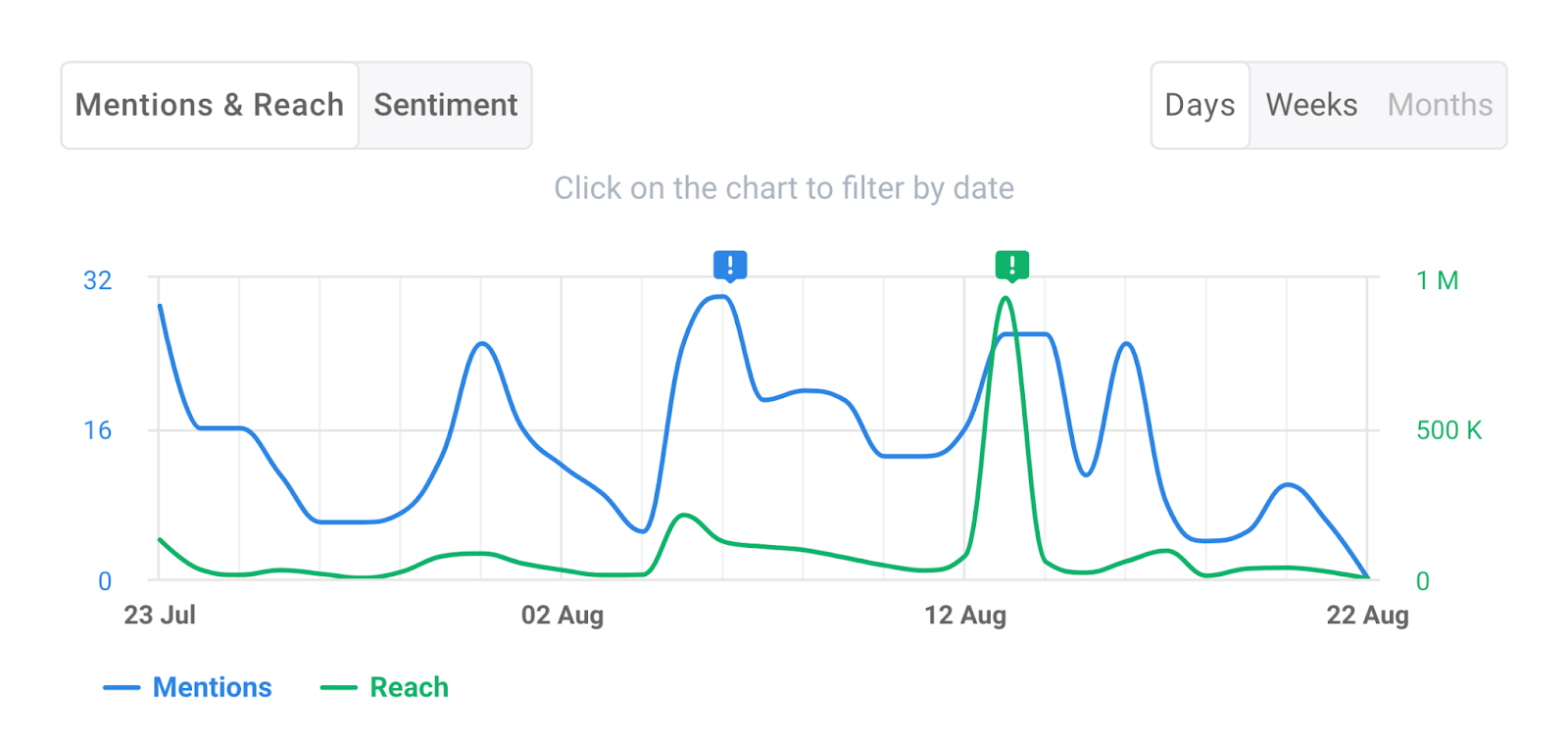
It's also added Chatbeat, an AI-visibility add-on starting at $99/month on top of a subscription, which tracks how you and your competitors appear in ChatGPT, Google AI Overviews, AI Mode, Gemini, and Perplexity. That's a real differentiator in this list, though the add-on pricing stings on top of an already expensive plan.
Brand24 is worth the money if reputation and share of voice are what you're actually measuring, rather than post performance.
Know when to close the tab
It's easy to get swayed by competitor research, getting overly invested in a rival's growth or decline, comparing your metrics with theirs, constantly checking what they're up to.
We're a bit wary of competitor analysis at Buffer, if we're honest. Not because it doesn't work (it does), but because it's the easiest kind of work to hide in. Checking a rival's follower count feels productive in a way that writing your ninth draft doesn't.
So here's the test worth applying: after a competitor analysis session, can you name one thing you'll do differently this week? If yes, the tool earned its money. If you just feel vaguely behind, close the tab. That feeling has never once made anyone's content better.
If you've got a tool on this list working well for you or you've tried one and bounced off it, I'd like to know which. Come and tell me what I got wrong.
FAQ about competitor analysis tools
What is the best way to do competitor analysis?
Pick three to five direct competitors, choose the two or three metrics that actually map to your goals, and track those on a fixed schedule rather than watching everything at once. A workable monthly loop: record each competitor's follower growth, engagement rate, and top three posts; note any new campaign, pricing change, or positioning shift; then write down one thing you'll do differently.
Tools make this faster, but the cadence matters more than the software. An inconsistent analysis with an expensive tool loses to a consistent one done by hand. Our full walkthrough with a downloadable template covers the whole process.
What are some effective SEO tools for competitor analysis?
Semrush (free plan, paid from $139/month) and Ahrefs (free tier, paid from $29/month) are the two most widely used. Both show a competitor's organic keywords, estimated traffic, backlink profile, and paid ads, and both surface keyword gaps (terms your competitors rank for and you don't).
Semrush has the broader marketing toolkit, including a social tracker; Ahrefs is stronger for backlink and content-gap research. Moz and SE Ranking are cheaper alternatives worth a look, and Similarweb answers the adjacent question of how much traffic a competitor's site gets overall. SEO competitor analysis and social competitor analysis are different jobs, and very few tools do both well.
How do you use ChatGPT for competitor analysis?
ChatGPT can’t pull live data directly from competitor websites, but it’s a useful thinking partner throughout the research process. You can ask it to:
- Help you build a competitor analysis framework or template
- Summarize publicly available information, like a competitor’s product page or pricing copy
- Spot patterns in data you’ve already gathered
- Generate questions to guide your research
For real-time metrics like traffic, keyword rankings, and brand mentions, you’ll still need a dedicated tool like Semrush or Brand24. Think of ChatGPT as a research assistant, not a data source.
What's the difference between competitor monitoring and competitor analysis?
Competitor analysis is a point-in-time assessment: You look at where a rival stands today and decide what it means. Competitor monitoring is continuous and alert-driven, telling you when something changes. Most of the tools here lean one way: Competitors App, Brand24, and Mention monitor, while SparkToro, Similarweb, and Semrush analyze. Rival IQ and Socialinsider both do this, which is part of what you're paying for. If you only look at competitors once a quarter, you want an analysis tool, and you're wasting money on alerts.
Which tools track competitors in AI search and AI Overviews?
This is the fastest-moving part of the category, and coverage is uneven. As of August 2026:
- Semrush has some AI visibility built into paid plans, but also sells AI Visibility as its own $99/month toolkit
- Ahrefs sells Brand Radar AI as a separate product from $199/month
- Brand24 offers Chatbeat as a $99/month add-on
- Meltwater shipped AI Visibility across ChatGPT, Gemini, Perplexity, and Copilot, and Cision added AI Search Visibility to its stack
- Rival IQ, Competitors App, Socialinsider, Social Status, vidIQ, and BuzzSumo have nothing here yet
Can I do competitor analysis without paid tools?
Yes. If you’re just starting out or working with a tight budget, you don’t need a paid subscription to gather useful competitive insights. You can manually review competitors’ social media profiles, website copy, and content strategy to spot patterns and gaps.
If you want some data without committing to a paid plan, a couple of the tools on this list offer free tiers: SparkToro (three free reports per month) and vidIQ, which also has a free plan.
For a step-by-step walkthrough, Buffer’s free competitor analysis guide includes a downloadable template to help you get started without any tools at all.
Last updated: 25 August 2026 · Tools reviewed: 11 picks and 14 alternatives · Pricing verified: August 2026
More social media marketing resources
- Buffer vs. Hootsuite: Which Social Media Management Tool Is Better For You?
- The Best Social Media Scheduling Tools (+ How to Find the Perfect Fit)
- The 11 Best Social Media Management Tools — Tried + Tested
- 13 Best URL Shorteners to Shrink Your Links
- Buffer vs. Meta Business Suite: How Do They Compare?
- Top 11 Social Media Engagement Tools to Build Your Community
Try Buffer for free
200,000+ creators, small businesses, and marketers use Buffer to grow their audiences every month.